
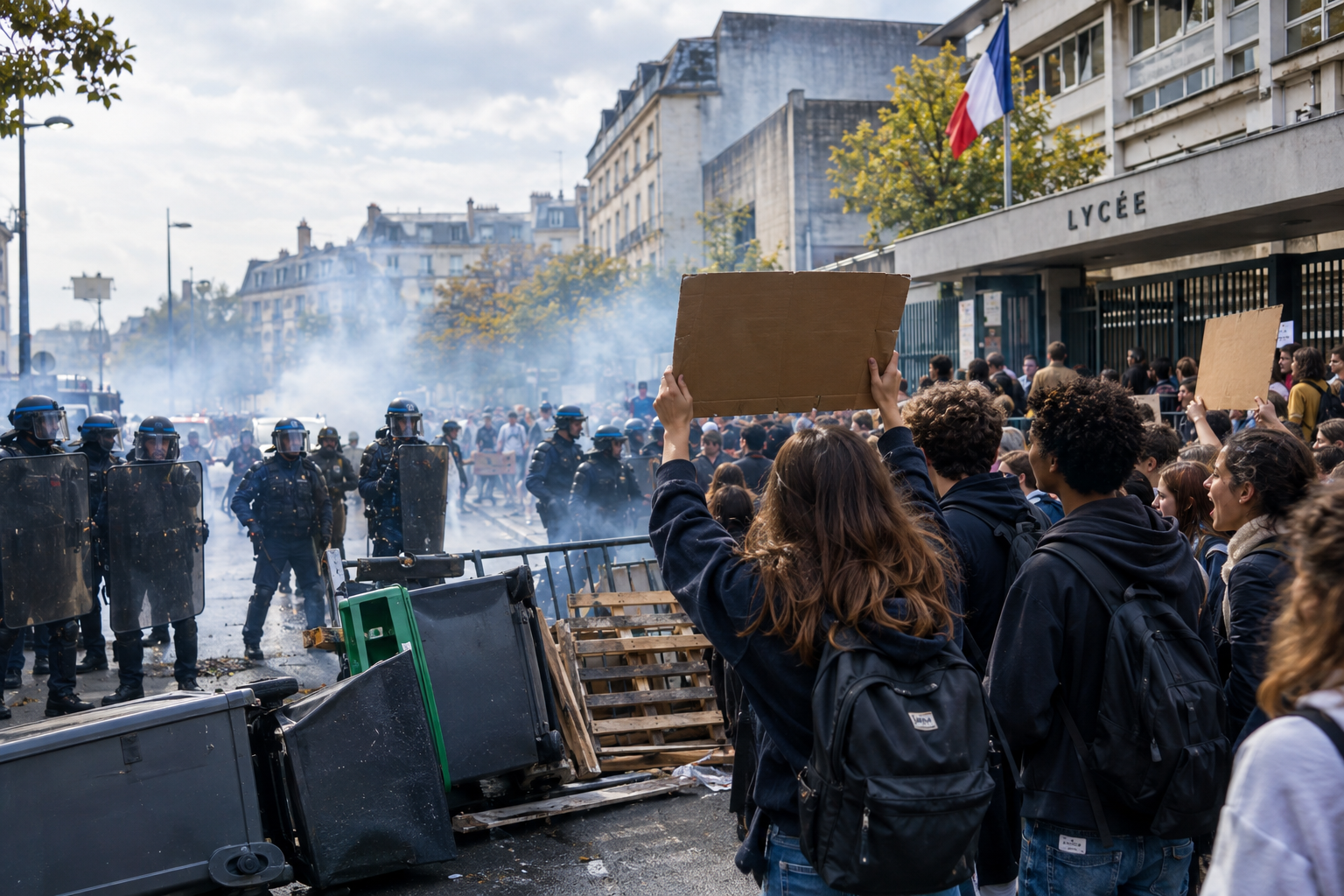
What began as a handful of blockades outside high schools near Paris has grown into one of the most serious domestic challenges the French government has faced this autumn. Teenagers are barricading school gates, police are responding with tear gas and batons, and the prime minister has pulled ministers off their travel schedules to deal with it. At the center is a question the country has argued over for years: who is responsible when public schools are failing the young people they serve?
A protest that spread fast
The demonstrations began last week in the Ile-de-France region around Paris, then spread to other cities, with students citing timetables, class sizes, teacher shortages and classrooms that overheated during recent heatwaves. The complaints are ordinary ones, the kind found in school systems across Europe. What has set this movement apart is its speed and its reach.
On one Tuesday, the education ministry said about 400 of roughly 3,700 high schools nationwide were affected by protests or disruption. A separate report put the figure that day at 416 schools, with 45 blockaded and attempted blockades at 46 others. Those numbers show how quickly a local grievance became a national one. ctvnewsnews
The scenes outside schools have been vivid. Teenagers set rubbish bins on fire and threw projectiles at police, who answered with batons and tear gas. In Nantes, students piled up bins at a school entrance during a day of public-sector strikes at the end of September.
Violence and its toll
Alongside the largely peaceful sit-ins, the protests have turned violent in places, and officials have been quick to say so. In Marseille, attackers set fire to a fire truck that had come to put out a blaze at a high school, and a headteacher at another school in the city was attacked and injured. Fires were reported at several schools, and there were no injuries in the Nantes incident, where the building was evacuated.
The human cost has mounted. The government reported 440 arrests on one day, mostly minors, and the education ministry counted 31 injured students and staff. Education Minister Édouard Geffray said staff had been hurt, including a teacher struck in the north of France and a headteacher injured by a firework near Paris. He called the violence unspeakable. By the following day, authorities said more than 600 people had been detained, and the interior minister described an escalation of violence outside certain schools.
Reported figures vary between outlets and days, and some early counts differ widely. The direction of travel is clear, though: more schools, more arrests and more injuries as the week went on.
The policing question
Students and their supporters say the government’s response has made things worse. One student held up a sign asking whether young people could explain themselves without being tear-gassed, and students have accused police of heavy-handed tactics. That criticism puts the authorities in a bind: they must restore order outside schools without appearing to punish teenagers for raising complaints many adults privately share.
Some adults have stepped in. One high school Spanish teacher said the repression of the protests led her to join her students. In Paris, after police used pepper spray on students marching from the Lycée François Ier, trade unionists who had come to support them formed a human chain to protect the young people from police violence. Images like these have drawn attention to the protests, and they complicate the government’s portrayal of events as disorder to be put down.
A mayor takes the students’ side
The most politically charged moment so far came in the Paris suburb of Seine-Saint-Denis, one of the country’s poorest districts. Mayor Bally Bagayoko of the hard-left La France Insoumise (LFI) joined a protest of hundreds of students at the Lycée Paul-Eluard, led them in singing the national anthem, and called the protests completely legitimate. His argument went to the heart of the dispute: low-income areas, he said, receive fewer resources than wealthier ones.
The mood changed quickly. When a crowd formed, riot police struck students and an AFP journalist with batons. The footage of an elected official standing between teenagers and police raised the protests’ profile and gave the opposition a powerful image.
It also fed the argument over who is behind the unrest. A CNN video circulating online shows a French mayor shielding students during the protests. I haven’t been able to verify that this is the Seine-Saint-Denis incident, so the report above should be read as one documented example of local officials siding with students.
Politics enters the classroom
Few things in France stay apolitical for long, and the school protests are no exception. Both President Macron and Interior Minister Laurent Nuñez have accused far-left groups of inciting violence, with Nuñez describing agitators who moved from school to school to stir up students. Officials and politicians have also criticized LFI and its presidential candidate Jean-Luc Mélenchon for rhetoric they say has stoked students’ anger. Mélenchon replied with a call of “Hands off our youth!” and urged LFI activists and officials to back the protests wherever they could. The prime minister’s office has gone further, judging that LFI organized the high school protests.
The accusation matters because it shapes the debate. If the protests are mainly the work of organized political agitators, the answer is policing and prosecution. If they reflect real frustration among students, the answer is investment and reform. Both views are being offered, and each side has reason to want its own account to win. Teenagers who organized a blockade over a heatwave-baked classroom are unlikely to see themselves as pawns in a party’s strategy, and the government’s critics argue that the label dismisses them.
What the government has said
Officials have tried to hold two positions at once. The government has condemned the violence that broke out during some protests but says the difficulties in high schools should be acknowledged and addressed. Prime Minister Sébastien Lecornu convened a crisis meeting and canceled ministers’ trips to focus on the spread of the protests. Geffray summed up the government’s line in a post on X, saying violence will not take away students’ fundamental right to an education.
That message tries to separate legitimate complaints from criminal acts, but the line is hard to hold in practice. Each report of arson or an injured teacher weakens the sympathy students need, while each image of riot police and tear gas against minors weakens the state’s claim to a measured response.
What to watch
Several questions will decide where this goes. The first is whether the government offers concrete commitments on staffing, class sizes and school buildings. Announcements about heat-proofing classrooms or hiring more teachers would speak directly to what students are asking for, but they cost money in a tight budget.
The second is whether the violence recedes. Attacks on staff and fire-setting give the authorities grounds for a harder line and cost the movement public support. If student organizers can keep protests peaceful, they have a better chance of being heard.
The third is how far the political fight escalates. With a presidential election approaching, both the government and its opponents have strong incentives to turn a school dispute into a test of strength. A debate that stays on timetables and teacher shortages favors the students, and one that shifts to who is manipulating whom favors the parties.
For now, French high schoolers have achieved something rare: they have forced a government to treat their complaints as a national emergency. Whether that leads to better schools or simply to a harsher security response will become clearer in the coming weeks.